
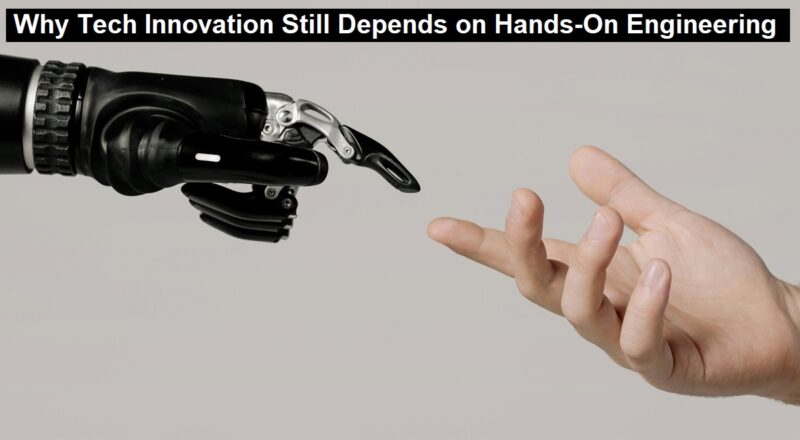
Technology headlines often focus on speed. Faster processors. Smarter algorithms. Systems that learn in real time. What gets less attention is what happens before any of that technology is switched on.
Every intelligent system still begins as a physical build. Hardware is positioned, secured, aligned, tested, adjusted, and tested again. This work happens long before software takes control, and it remains one of the most fragile points in any technology project.
Digital innovation may accelerate quickly, but physical systems move at a different pace. That difference matters.
Software Can Change Overnight. Hardware cannot
A line of code can be rewritten in minutes. A physical mistake can remain hidden for months.
In complex environments like data centres, robotics labs, or automated manufacturing floors, small setup issues have a way of multiplying over time. A bracket installed a few millimetres off. A mounting depth that was estimated instead of measured. A structural element that limits airflow more than expected.
As AI infrastructure expands, this gap between digital ambition and physical reality is becoming harder to ignore. The growing scale of data centres has placed new pressure on engineers to manage heat, load distribution, and mechanical stress with far tighter margins than before. These challenges have been widely discussed in recent industry coverage by MIT Technology Review. Advanced software does not compensate for unstable foundations. It exposes them.
Robotics and IoT Are Physical Systems First
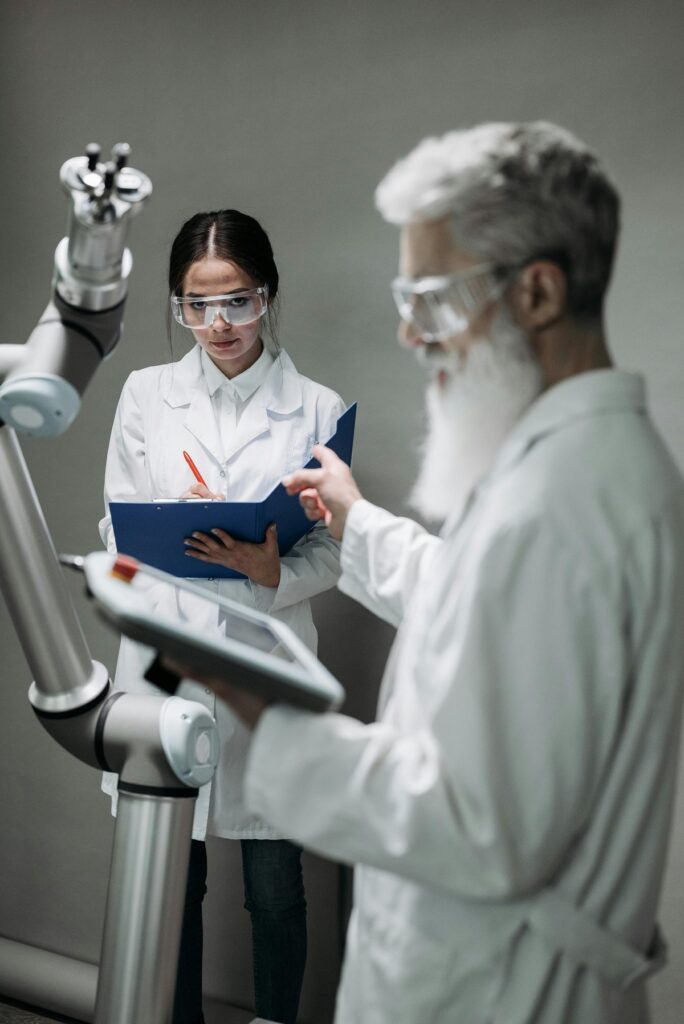
Robotics and connected devices are often discussed as software ecosystems. In practice, they are mechanical systems long before they are digital ones.
Sensors only perform as expected when positioned correctly. Actuators only move reliably when mounted with precision. Enclosures must balance protection, access, and durability without interfering with operation.
Engineers working in these environments frequently deal with physical constraints that never appear in design mockups. Tight enclosures. Limited access points. Structural layers that require deeper reach during installation or modification. In these situations, tooling choices become practical decisions rather than technical preferences. Equipment such as long series drill bits is used quietly during assembly and integration work, enabling access where standard tools fall short without disrupting surrounding components. This kind of work rarely features in innovation case studies, yet it plays a direct role in system reliability.
Precision Is Not Optional at Scale
As technology systems grow larger and more interconnected, physical accuracy becomes harder to recover once lost.
A server rack that restricts airflow may perform adequately at low load, then fail under peak demand. A misaligned sensor might produce data that looks acceptable until decisions based on that data start drifting off course. These are not theoretical risks. They are common causes of downtime in advanced facilities.
Research from McKinsey continues to show that advanced manufacturing and automation depend heavily on precision engineering to sustain performance as systems scale. At this level, precision is no longer about craftsmanship alone. It becomes a strategic requirement.
Read: Power of Persuasive Personalization: A Growth Hack for Marketers
The Human Element Has Shifted, Not Disappeared
Automation has changed the role of engineers, but it has not reduced the need for human judgment. Modern engineering work sits between digital abstraction and physical reality.
Engineers now move constantly between system diagrams, simulation outputs, material behaviour, and on-site constraints. Software can predict outcomes, but it cannot account for every variable introduced by real environments, existing structures, or imperfect surfaces.
Hands-on adjustments, informed by experience rather than models, remain a critical part of deployment and maintenance. This is especially true during upgrades, retrofits, and integrations, where ideal conditions rarely exist.
Progress Lives in the Overlap
The most successful technology systems are not purely digital or purely mechanical. They exist in the overlap between the two. AI, robotics, and connected systems reach their potential when digital intelligence is supported by solid engineering fundamentals. Stable structures. Accurate alignment. Thoughtful installation. Tools chosen for function rather than convenience.
Innovation does not move forward by replacing hands-on engineering. It moves forward because that engineering continues to evolve alongside the software it supports. Tech innovation still depends on people who understand how things fit, hold, move, and endure in the real world.