
What makes you pause and give your full attention to a message as you keep scrolling through dozens of others? Sometimes, it’s all about the timing. Other times it’s simply the way it strikes exactly what you’re already thinking about. Whatever the factor is, it strikes you as personal, and that is what makes all the difference.
That is the strength of persuasive personalization. More than putting the name of a person in the email or showing a product that the individual last glanced at the screen. It is about applying genuine insights to develop experiences that seem to belong to the one watching it. It does not only attract attention when done properly. It generates trust, a sense of being understood, and creates a more confident decision-making. And this is not something nice to have. Approximately 86% of customers state that personalization affects their purchasing decisions. Conversely, 58% report being frustrated when brands fail, or the messages they receive do not seem relevant. This gap reveals just how far you can still go, but also how high you can rise when right.
And many of the brands have already done so. Revive Our Hearts, as an example, identified the 10 percent of most engaged users on their websites and offered them a more customized manner to donate. The single change caused an increase of 48 percent in monthly donors. They experienced actual measurable growth just by knowing what their audience was and giving them the right message at the right time.
In this blog, we will continue to dive deeper into how influential and valuable personalization has become. We are going to discuss the psychology of it, how to work out a good strategy based on data, how to measure its effectiveness, and what other things marketers can do to make every interaction more meaningful.
1. Why Personalization Matters in Modern Marketing
With the answers to the importance of personalization being known, it is now time to get to grips with what indeed makes this personalization work out. Why are some messages so relevant that we act on them without much thinking, and others are left in the background?
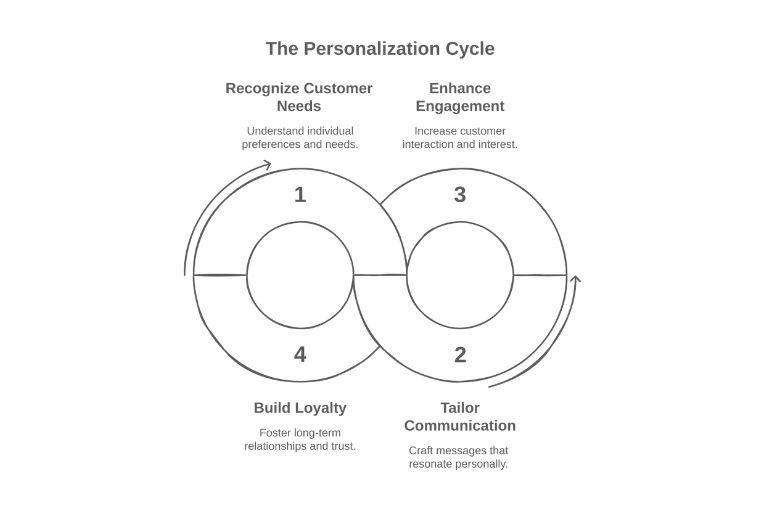
Turns out that there is much psychology in it. When the message seems personal, it seems to be more relevant. And relevance has a good influence on our response. It generates a feeling of closeness. It makes us feel like someone is listening to us, which makes us more receptive to what they are saying. Such emotional appeal is among the main reasons why persuasive personalization is so effective. It is not only informative. It influences. The impact of this can be even greater when coupled with the proper timing. For instance, a message arriving at the time a person is already thinking about a problem or seeking a solution is like receiving a gentle nudge. Relevance combined with timing can make curiosity into action. And this is the part where technology, particularly artificial intelligence, can make a huge difference.
AI is transforming the approach to personalization. It assists in the cognition of patterns in behavior, preferences, and even language. It is able to review massive quantities of data in sites such as Reddit or Twitter and understand the way individuals refer to particular products, services or requirements. It then leverages that information in order to craft messages that are both natural and compelling. In one particular study, AI-generated arguments personalized to the recipient were found to have an agreement rate over 81 percent higher than when the same arguments were produced by humans. This is a clear demonstration of the effectiveness of well-informed personalization.
However, there is a responsibility attached to this power. Marketers should seek to act responsibly and ethically when using these tools. Personalization is meant to assist other individuals, not stress them. It must influence and not dictate. At its best, it can cultivate trust rather than destroy it.
Read: AI Consulting for Startups: How Early-Stage Businesses Can Compete With Giants
2. The Science of Persuasive Personalization
With the answers to the importance of personalization being known, it is now time to get to grips with what indeed makes this personalization work out. Why are some messages so relevant that we act on them without much thinking, and others are left in the background?
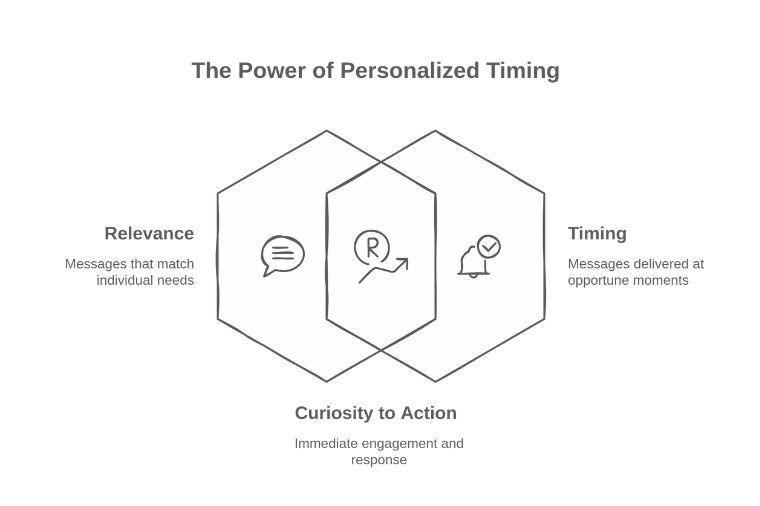
Turns out that there is much psychology in it. When the message seems personal, it seems to be more relevant. And relevance has a good influence on our response. It generates a feeling of closeness. It makes us feel like someone is listening to us, which makes us more receptive to what they are saying. Such emotional appeal is among the main reasons why persuasive personalization is so effective. It is not only informative. It influences. The impact of this can be even greater when coupled with the proper timing. For instance, a message arriving at the time a person is already thinking about a problem or seeking a solution is like receiving a gentle nudge. Relevance combined with timing can make curiosity into action. And this is the part where technology, particularly artificial intelligence, can make a huge difference.
AI is transforming the approach to personalization. It assists in the cognition of patterns in behavior, preferences, and even language. It is able to review massive quantities of data in sites such as Reddit or Twitter and understand the way individuals refer to particular products, services or requirements. It then leverages that information in order to craft messages that are both natural and compelling. In one particular study, AI-generated arguments personalized to the recipient were found to have an agreement rate over 81 percent higher than when the same arguments were produced by humans. This is a clear demonstration of the effectiveness of well-informed personalization.
However, there is a responsibility attached to this power. Marketers should seek to act responsibly and ethically when using these tools. Personalization is meant to assist other individuals, not stress them. It must influence and not dictate. At its best, it can cultivate trust rather than destroy it.
3. Building a Data-Driven Personalization Strategy
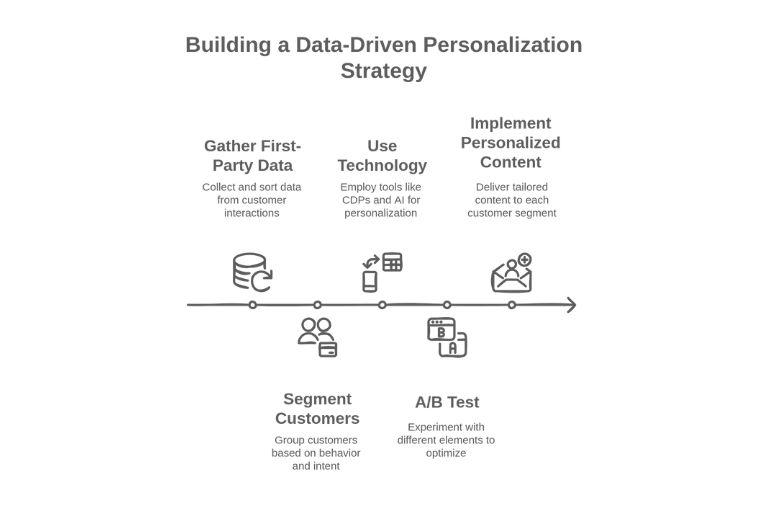
Having discussed the psychology and technology behind perspective personalization, it is time to determine the way to implement it. It is one thing to know that timing, relevance and trust can affect behavior. Designing a plan that incorporates those concepts to influence actual customer experience is where the real work begins.
- Start with First-Party Data
Data is at the core of this approach. In order to craft messages people can experience as personal and persuasive, we must start by seeing who we are speaking to. It begins by gathering and sorting first-party data, which includes everything, such as how a person interacts on your site, what they click on, search, and preferences they have disclosed to you directly. Such data provides a clear picture of who your customers are, and enables easier one-to-one messages at the right time.
2. Segment Based on Behavior and Intent
After laying that foundation, what follows then is segmentation. This implies segmenting your customer into groups according to their areas of concern, proximity, or their usage of the products. As an example, a visitor who returns frequently to your pricing page within a week may be more likely to convert than one who is merely browsing through your blog. Becoming aware of such patterns allows you to create content that will resonate with each group, be it a demo invitation, a quick-start or a special offer.
3. Use Technology to Scale Personalization
This process can be scaled with the help of technology. Customer data platforms, together with AI tools, are able to process significant amounts of information and identify insights, which would be difficult to execute manually. They automate the experience, meaning that whatever shows up will be something that each user thinks is custom-made, thus, not requiring you to change every message on your own.
Here, Conversion Rate Optimization platforms (CRO) also play a big role. These tools allow you to A/B test various headlines, layouts, or calls to action depending on visitor behavior and continue to maintain a personal experience. The fact that these platforms can have persuasive design built-in mechanisms already makes them even more effective in moving the users into action after developing interest.
Suppose that you are a SaaS business that provides project-management tools. The first step is to monitor the activities of the users of various categories on your site. You can see that small teams tend to read about collaboration opportunities, whereas individual freelancers prefer task management tricks. With such knowledge, you come up with various landing pages per category. The first one emphasizes the way in which a team may smooth its operations, whereas the second one is all about personal productivity. Next, you use a personalization platform to ensure that every visitor is automatically presented with the page best suited to them.
You experiment with messages and impressions with time to see what sticks. This aids in both overall conversion and site performance as you can serve your target audience effectively. As we have already observed in previous applications such as Revive Our Hearts and Bowery Mission, even modest changes can make a huge difference when they are based on a clear insight of the audience. The aim is not only to make it personal, but purposeful by making every moment personalized.
4. Measuring the Impact of Personalization
After a personalization strategy is underway, the challenge is then presented on what exactly it is accomplishing. We discussed how to use data to bring people to a certain action but now it is time to consider how these actions are formulated into actual outcomes.
- Tracking the Right Metrics
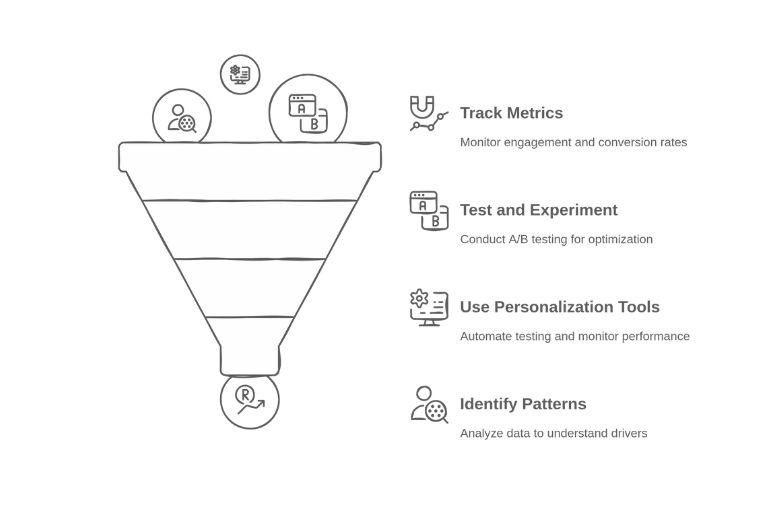
The key to all this is proper tracking of the right metrics. Engagement rates, conversion rates, and growth in actions such as donations assist in demonstrating the response of people. These figures provide a snapshot of whether the experience is relevant and whether it is fostering the desired behavior. We have previously observed this in the case of Revive Our Hearts and Bowery Mission, where great results were only made possible through emphasizing what mattered and tracking it closely.
2. Testing and Experimentation
In order to go further with those outcomes, testing is necessary. Differences in versions of a message or layout, to be tried, can result in finding out what works better. Such effort at experimentation might appear small, but in the long run, it makes the campaigns smarter and more effective. It also transforms the system of guessing to learning, where every decision is supported by actual feedback.
This is once again where personalization tools would come in. As stated above, conversion optimization platforms have the capability to automate tests and monitor their performance in real-time. They assist you to know which variation of a message or call to action prompts more clicks. These tools do not only simplify the scale of personification, but they also simplify measurement and enhancement, especially when built on a strong web design process that supports digital marketing.
3. Challenge of Attribution
Well, of course, personalization is not always easy to measure. Determining what happened, particularly what brought about a change, is one of the widely known problems. Was it because of the message, the timing, or what? That is when recurrent monitoring and pattern identification are useful. You start seeing patterns in many campaigns rather than a singular campaign and you gain more clarity and residence over what is actually driving results.
The most valuable part about this process is the fact that it feeds back into your strategy. As you did in the beginning, the performance data now refines the personalized messages that you create. Every piece of new knowledge is a step in the right direction, as you end up keeping with what the audience genuinely desires.
Conclusion
Persuasive personalization has emerged as one of the principal tactics used by marketers to enhance engagement and conversions and establish better relationships with customers. Through information and on-time insights, brands are able to provide experiences that seem relevant and meaningful. When perfectly executed, personalization does not just gain attention but initiates actual business results.
Marketers must emphasize the use of data-driven approaches that are not only effective but also ethical, to stay relevant. The high-intent segment may be a fast way to achieve a win, and tools such as AI can scale such efforts in precision. With consumer expectations ever-increasing, personalization is an evident light at the end of the tunnel for marketers willing to establish lifetime loyalty and sustainable growth.
Author’s Bio
Vidhatanand is the Founder and CEO of Fragmatic, a web personalization platform for B2B businesses. He specializes in advancing AI-driven personalization and is passionate about creating technologies that help businesses deliver meaningful digital experiences.