
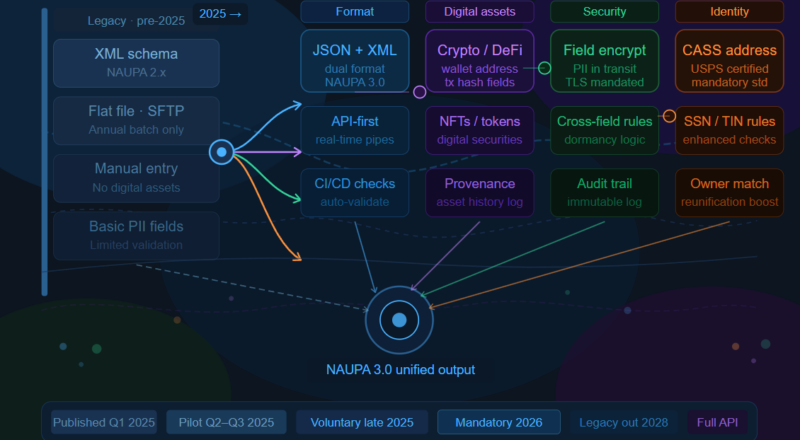
The National Association of Unclaimed Property Administrators (NAUPA) has been the key to the standardization of exchange of information between the holders and the state treasuries. With the financial industry transitioning to an asset where digital is the main focus, the future 2025 guideline update of NAUPA is an important milestone in the industry. There is no such thing as a standard update, but this one is a complete technical refresh and changes to suit new types of properties and modernize the data interchange formats.
These new standards involve major technical system alterations on thousands of holders and 50+ jurisdictions. The 2025 guidelines will transform the way compliance is measured and implemented by adding tokenized assets to expanding schemas and adding support to JSON. This paper examines the technical path of these standards and gives a roadmap of their implementation.
Overview of NAUPA Standards and Their Importance
Standardization is the bedrock of the unclaimed property ecosystem. In the absence of NAUPA framework, the holders would have to wade through a forest of 50 possible reporting forms, with errors and audits going exponentially up. The existing XML-based standards have been a good fit to the industry, though the emergence of cryptocurrency, NFTs and stablecoins have taxed the existing schema to the maximum.
The main reasons behind the 2025 update are the necessity to achieve better data quality, stronger security measures, and the shift to API-based reporting. Through these standards, states will be able to raise their reunification rates and minimize the administrative burden on holders. As noted in recent regulatory technology reports, the evolution of such standards is essential for maintaining integrity in an increasingly complex global financial market.
Key Technical Changes in 2025 Standards
The 2025 guidelines present some structural changes that will necessitate urgent focus of IT and compliance teams.
Schema and Format Modernization
XML is a staple, but NAUPA 3.0 schema has a native implementation of JSON (JavaScript Object Notation). The move helps to integrate more easily with modern web applications and cloud-native services. To prepare such multi-format reporting requirements, developers are advised to look at W3C data standards, so that data pipelines can convert internal data records into validated JSON or XML payloads with minimal error.
Digital Assets and Enhanced Fields
The most significant addition is the inclusion of digital-native property types. This includes:
- Cryptocurrency and DeFi Holdings: Special fields of wallet addresses and transaction hashes.
- Tokenized Assets: Digital securities and NFTs.
- Expanded Identity Data: Tighter checking of SSN/TIN fields and required address standardization of USPS CASS certifications.
Security and Validation
The 2025 standards will require the field-level encryption of sensitive PII when transmitted to address the increasing privacy concerns. Tighter cross-field validation checks will also be imposed, including checking that the “Date of Last Contact” makes sense with the dormancy period of the type of property.
Implementation Requirements and Timeline
A transition to the new standards is a timeline of rigorous actions over a period of many years. After the official publication in early 2025, a pilot program will be implemented during the third quarter, and voluntary adoption will be open in late 2025. It will be required to comply by the 2026 reporting cycle, and the use of legacy formats will end completely by 2028.
Companies need to revamp their compliance reporting system to accommodate the new NAUPA standards and this will necessitate a liaison of legal, IT and finance departments to enable timely compliance and prevent fines. This upgrade will require database schema upgrades to accommodate digital asset fields and their related fields, changes in UI/UX to provide manual entry-points, and: adjustments to SFTP/HTTPS transmission protocols to align with the new security requirement.
Testing and Validation
NAUPA will provide a dedicated validator tool to help holders verify their files before submission. Software vendors and large-scale holders will be important participants in state acceptance testing windows to detect edge case errors in the new schema before the deadlines are mandatory.
Read: How Autonomous Sales Technology Is Changing Lead Management
Technical Challenges and Solutions
The move to NAUPA 2025 is not without its hurdles. Many organizations still rely on legacy ERP systems that struggle with the precision required for digital asset reporting. Incomplete historical data (particularly regarding the “provenance” of digital property) can lead to validation failures.
Overcoming Integration Complexity
To reduce these issues, a number of companies are taking a step-by-step implementation strategy. Data cleaning and transformation can be achieved through middleware that uses legacy systems to connect to the new API-first reporting needs, without completely overhauling the system. Continuous Integration (CI) pipelines can be configured to run NAUPA validation rules automatically whenever property data is updated, ensuring “reporting-ready” data throughout the fiscal year.
One of the pitfalls is to underestimate the time needed to coordinate with the vendors. Software providers require holders to discuss their compliance tool with them early in order to assure that their third-party compliance tool will be certified to the 3.0 schema far before the 2026 reporting cycle. To elaborate on complex regulatory transition, Enterprise Architecture frameworks have helpful strategies to align IT strategy with compliance mandates.
Strategic Opportunities from Standards Update
Although compliance is a regulatory requirement, the update of 2025 has strategic benefits. The move towards JSON and API based reporting is a driver towards wider modernization of technology. Switching to API-first will allow organizations to remove the need to enter data manually and adopt real-time compliance monitoring, and essentially transform a once-a-year headache into a new, automated system.
Beyond improving reporting workflows, organizations should also consider the end-user experience once unclaimed property is identified. Providing clear guidance on how individuals can claim your funds helps reduce customer frustration, builds trust, and increases the likelihood that dormant assets are successfully reunited with their rightful owners. Resources such as ClaimNotify offer educational information about the unclaimed property process and can help individuals understand the steps required to claim your funds, complementing an organization’s broader compliance and customer service efforts.
Moreover, the quality of data will also be improved and it will consequently decrease the accumulation of unclaimed property. Holders are able to fix dormant accounts prior to the stage of escheatment with more matching and reuniting features, resulting in a better customer retention and minimizing liability on the balance sheet in the long term.
Conclusion
The evolution of NAUPA standards is an inevitable response to the digitization of wealth. Although the 2025 guidelines are technically challenging, they introduce a way to more efficient, secure, and automated reporting. With the 2026 requirement Don’t wait to begin your compliance journey. This regulatory need can be turned into a competitive advantage by assessing your compliance reporting system today and participating in industry working groups. The minimum is compliance, but the real opportunity is to what extent you succeed in your technical transition.